

Table of contents
- Quick answer
- The key distinction, fits, works, and works well are different questions
- Why DSLR lenses usually need adapters on mirrorless cameras
- What still works when you adapt a DSLR lens?
- What changes or gets worse with adapted DSLR lenses?
- Why compatibility depends on the system
- Works well, works with caveats, or usually not ideal?
- When adapting is worth it
- When native mirrorless lenses make more sense
- A practical switching plan for DSLR owners
- Common mistakes when adapting DSLR lenses
- So, should you adapt DSLR lenses or buy native mirrorless lenses?
Here is the short version:
| Question | Short answer |
|---|---|
| Can DSLR lenses work on mirrorless cameras? | Often yes, with the correct adapter. |
| Do they work exactly like native mirrorless lenses? | Not always. |
| Will autofocus, stabilization, and aperture control always work fully? | No. That depends on the lens, body, adapter, and firmware. |
| Is adapting a good idea for existing DSLR owners? | Often yes, especially as a gradual switch. |
| Is adapting a good idea for a beginner starting from zero? | Usually not the simplest path. |
| Are all brands and lenses equally compatible? | No. Support is system-specific and sometimes lens-specific. |
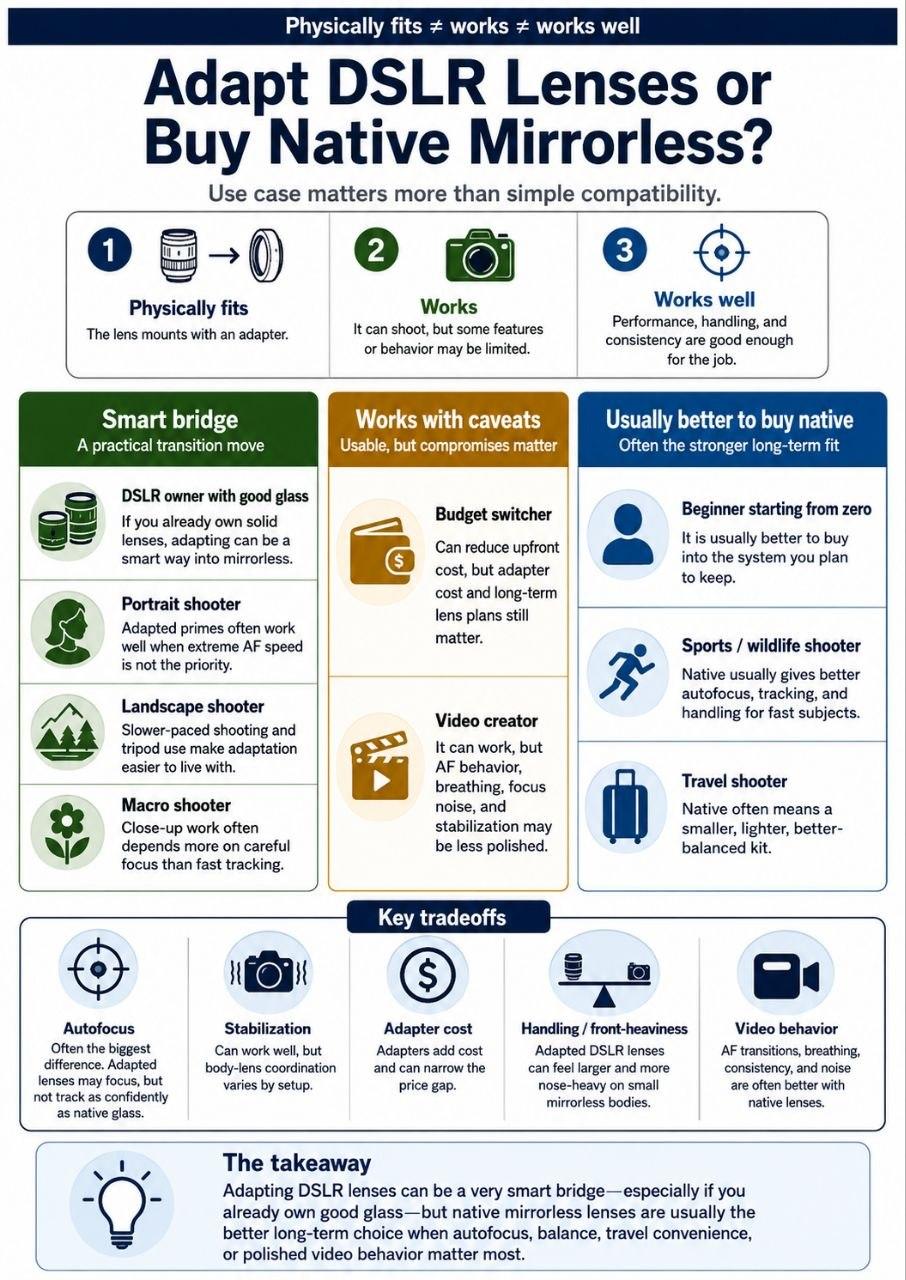
The key distinction, fits, works, and works well are different questions
This is the most important idea in the article. If you have not locked the broader system question yet, start with what is a mirrorless digital camera so the adapter decision is tied to the bigger body-and-lens tradeoff.
A lens can be:
- physically mountable
- electronically supported enough to function
- good enough in real use to keep long term
Those are not the same thing.
A lens may fit the camera and still leave you with:
- weaker autofocus behavior
- uneven tracking
- uncertain third-party compatibility
- awkward front-heavy handling
- less pleasant video performance
That is why a generic “yes, just use an adapter” answer is not enough.
The better framework is to ask five separate questions:
- Will it mount?
- Will the camera control the aperture properly?
- Will autofocus work, and how well?
- Will stabilization behave properly?
- Is the result worth it compared with buying a native lens instead?
Adapt DSLR Lenses or Buy Native Mirrorless?
Why DSLR lenses usually need adapters on mirrorless cameras
DSLR and mirrorless cameras use different mounts and different physical spacing.
Mirrorless cameras usually have a shorter flange distance, which means there is physically more room between the lens mount and sensor. That is what makes adaptation practical in the first place. The adapter fills that space and creates the mount conversion.
That is why adapting DSLR lens to mirrorless body is often possible.
The reverse, adapting a mirrorless lens to a DSLR body, usually is not practical in the same straightforward way.
There are also different types of adapters.
Passive adapters
These are simpler adapters used mainly for fully manual lenses or situations where you do not need electronic communication.
Electronic adapters
These are the ones that matter most for modern DSLR lenses because they try to preserve things like:
- aperture control
- autofocus communication
- image stabilization behavior
- EXIF data
This is also why every adapter is not basically the same. The difference between passive and electronic support changes the whole experience.
What still works when you adapt a DSLR lens?
A lot depends on the specific system, but these are the main areas to think about.
Physical mounting and focusing to infinity
With the correct adapter, this is often possible.
Aperture control
This often works best when you are using an official or well-supported electronic adapter path. A fully electronic DSLR lens on a passive adapter is a different story.
Autofocus
Sometimes autofocus works very well. Sometimes it works only adequately. Sometimes the combination is too compromised to recommend for your main use.
This is one reason first-party same-brand adapter paths are usually safer than random combinations.
Stabilization
Lens stabilization and body stabilization may both be involved, but support varies. Some systems handle this cleanly. Others need more careful compatibility checking.
EXIF and camera communication
In strong electronic adapter paths, this may stay mostly intact. In simpler or more limited adapter paths, it may not.
What changes or gets worse with adapted DSLR lenses?
This is the part buyers often underestimate.
Handling and balance
A DSLR lens plus an adapter can feel front-heavy on a small mirrorless body.
That does not mean it is unusable, but it can cancel some of the size and weight appeal that attracted people to mirrorless in the first place.
Autofocus behavior
A lens may autofocus, but not with the same confidence, consistency, or tracking behavior you would expect from a strong native mirrorless setup.
Video behavior
A lens that is fine for stills may be less appealing for video if it has:
- noisier autofocus
- less reliable subject tracking
- awkward balance
- weaker stabilization coordination
Convenience
Some adapted setups are workable but not elegant. That matters more if the lens is going to live on the camera all the time.
Why compatibility depends on the system
This is not one universal answer across every brand.
Canon EF and EF-S to EOS R
Canon’s official EF-EOS R adapter path is one of the cleaner examples of how adaptation can work well inside a brand ecosystem. Canon also supports EF-S lenses on EOS R bodies, with the expected crop behavior when using a smaller image circle on a larger-format body.
Nikon F to Nikon Z
Nikon’s FTZ II path is also real and useful, but Nikon is explicit that support depends on lens type. That alone tells you why this article cannot honestly say “yes, all DSLR lenses just work fine on mirrorless.”
Sony A-mount to E-mount
Sony’s adapter ecosystem also shows the same pattern. Adaptation exists, but body and lens compatibility can include restrictions.
Four Thirds to Micro Four Thirds
Panasonic’s compatibility guidance is another good reminder that “basic compatibility” is not the same as “full performance.” Firmware also matters more than many buyers expect.
Works well, works with caveats, or usually not ideal?
This is where the decision gets clearer.
| Use case | Adapted DSLR lens verdict | Why |
|---|---|---|
| Landscape photography | Often works well | AF demands are lower, and handling is less rushed. |
| Portraits | Often works well | Good existing glass can still be worth keeping. |
| Macro | Often works well | Manual focus and slower work reduce the pain of adaptation. |
| Studio or product work | Often works well | Controlled conditions reduce the pressure on AF and balance. |
| Travel | Works with caveats | Adapted DSLR lenses can reduce the size advantage of mirrorless. |
| Wildlife | Works with caveats | Long telephotos may be worth keeping, but AF/tracking needs checking. |
| Sports or action | Works with caveats | Fast AF and tracking matter much more here. |
| Video | Often less ideal | Native lenses are usually cleaner for AF, silence, balance, and stabilization. |
| Beginner starting from zero | Usually not ideal | Native mirrorless is simpler and cleaner. |
When adapting is worth it
Adapting DSLR lenses usually makes the most sense in a few situations.
You already own good DSLR lenses
If you already have useful glass, adapting can lower the cost of moving to mirrorless.
The lens is expensive or specialty glass
If replacing the lens natively would be expensive, adaptation can be a smart bridge.
Your use is slower or more controlled
Portraits, landscapes, macro, and some studio work usually tolerate adaptation better than fast action or demanding handheld video.
You want to switch gradually
This is one of the strongest reasons to adapt. You can move into a mirrorless body first, then replace the lenses that actually create friction later.
When native mirrorless lenses make more sense
Sometimes the adapter solution is technically possible but strategically weak.
You are starting from zero
If you do not already own DSLR lenses, native mirrorless lenses are usually simpler.
You care a lot about video
For many video shooters, native lenses are the cleaner long-term choice because autofocus behavior, noise, stabilization, and balance matter more. That is the same reason are mirrorless cameras better for video usually lands on mirrorless as the cleaner modern video platform, but not automatically with adapted glass.
You want the most compact setup
A DSLR lens plus adapter can make a small mirrorless body feel less elegant than expected.
The adapter plus old lens cost is not actually a bargain
This gets missed a lot. A used DSLR lens plus adapter is not automatically cheaper or better value than a sensible native mirrorless lens.
A practical switching plan for DSLR owners
If you already own DSLR lenses, the most sensible move is usually not to panic-buy a whole new lens kit.
A better approach is:
- List the DSLR lenses you actually use often.
- Check official support for each lens, body, and adapter path.
- Start with the strongest first-party or well-documented adapter route.
- Move to the mirrorless body first if your key lenses are well supported.
- Replace only the lenses that create real friction in autofocus, video use, size, or handling.
- Keep specialty DSLR lenses if they still do the job well.
That turns adaptation into a staged upgrade path instead of a forced full-system reset.
Common mistakes when adapting DSLR lenses
Assuming “fits” means “fully works”
It does not.
Buying the wrong adapter
Mount compatibility is not something to guess at.
Ignoring lens motor type and lens generation
Older or less compatible lenses may not behave the same way as newer lenses inside the same mount family.
Confusing crop factor with adaptation
The adapter itself usually is not what changes the field of view. Sensor size or crop mode is the bigger issue in normal setups.
Forgetting the handling cost
Even when the lens works well enough, the balance may be worse than expected on a smaller body.
Assuming third-party DSLR lenses are guaranteed
Some work very well. Some are more hit-or-miss. That is exactly why you need exact compatibility checking.
So, should you adapt DSLR lenses or buy native mirrorless lenses?
If you already own good DSLR glass, adapting can be a smart bridge into mirrorless.
If you are starting from scratch, want the cleanest setup, care a lot about video, or want the most predictable autofocus and handling, native mirrorless lenses usually make more sense. Beginners deciding whether to simplify or stretch an old kit should also read are mirrorless cameras good for beginners.
The best short answer is:
Yes, you can often use DSLR lenses on mirrorless cameras. But whether you should depends on whether the lens does the job well enough, not just whether it physically mounts.
Before buying, always check the exact lens, body, adapter, and firmware combination rather than assuming a mount match tells the whole story.
If you are still working through the bigger system decision, start with what a mirrorless camera is, then compare the broader switching from DSLR to mirrorless question and the more specific topic of native vs adapted lenses for video.
