

Table of contents
- Quick answer
- Why mirrorless can be easier to learn on
- What mirrorless does not magically fix
- Mirrorless vs DSLR for beginners, the practical difference
- Are mirrorless cameras too expensive for beginners?
- What features actually matter for a beginner mirrorless camera?
- Is a viewfinder important for beginners?
- Beginner mistakes to avoid when buying mirrorless
- When a beginner might still be better off with a DSLR
- Beginner decision matrix
- So, should your first camera be mirrorless?
If you want the fastest version, here it is.
| Beginner situation | Best starting point | Why |
|---|---|---|
| First interchangeable-lens camera, buying new | Usually mirrorless | Live preview, modern autofocus, and current system support help many beginners. |
| Very tight budget | Often used DSLR or older mirrorless | Best value is not always the newest format. |
| Mainly learning still photography | Mirrorless or DSLR | Mirrorless helps with preview; DSLR can still be a low-cost learning tool. |
| Hybrid photo/video beginner | Usually mirrorless | One system handles both more naturally. |
| Phone upgrader | Often mirrorless | Screen-based shooting and autofocus can feel more familiar. |
| Existing DSLR lens owner | Depends | Lens compatibility and switching cost matter. |
That is the big distinction this page needs to protect:
good for beginners is not exactly the same as best value for beginners.
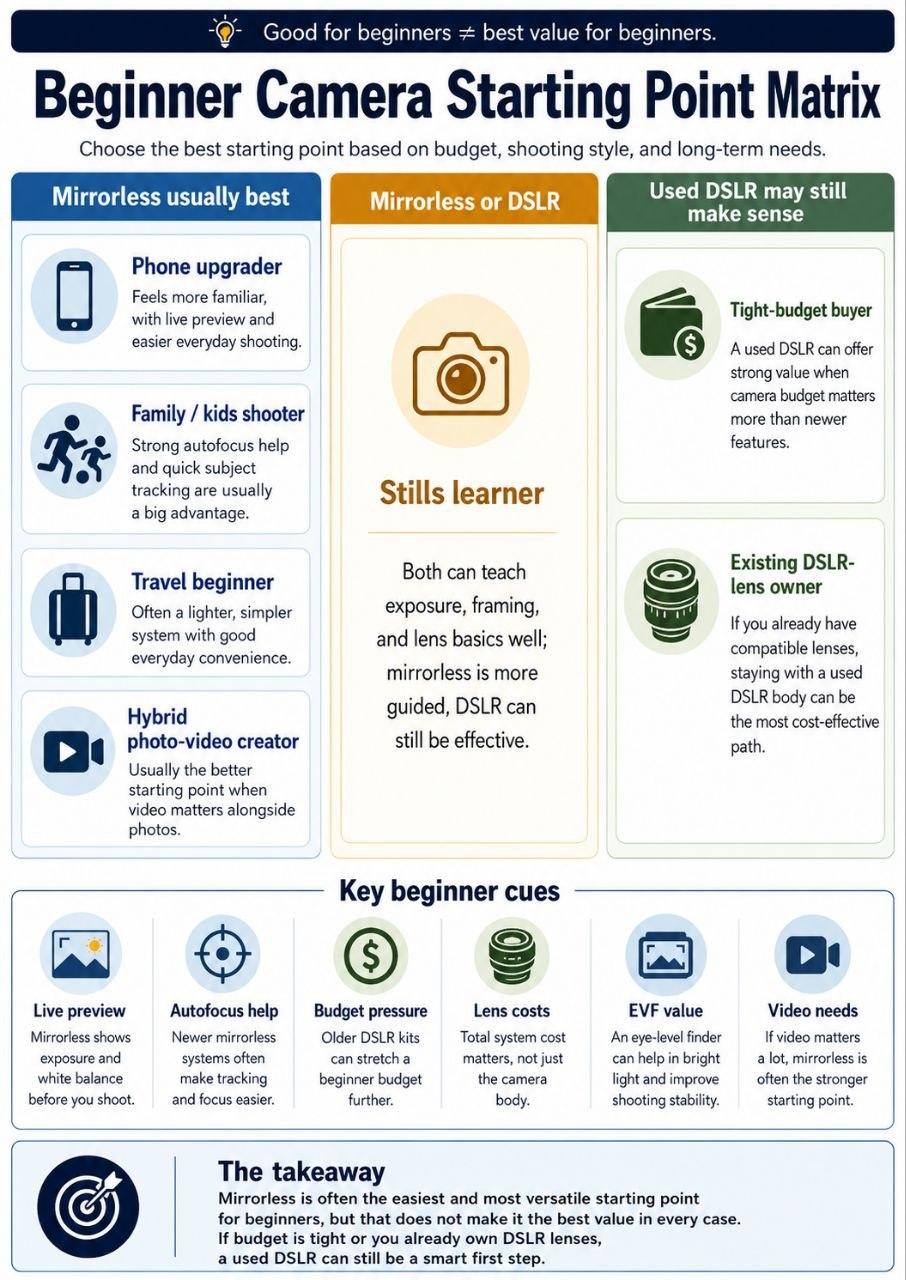
Beginner Camera Starting Point Matrix
Why mirrorless can be easier to learn on
This is the strongest argument for mirrorless as a beginner camera category.
You can see more before you take the photo
Many mirrorless cameras let you preview the scene through the EVF or rear screen in a way that helps beginners connect settings to outcomes faster.
Changes to exposure, white balance, and other shooting settings are often easier to understand when the camera shows you more of the effect before capture.
That does not teach photography for you, but it can shorten the feedback loop.
Autofocus can reduce frustration
Modern mirrorless cameras often give beginners stronger autofocus help than older beginner DSLRs, especially for:
- people
- kids
- pets
- casual movement
- hybrid photo/video use
This matters because many beginners are trying to learn exposure and composition at the same time. Reliable autofocus removes one source of friction.
Screen-based shooting feels more familiar to some beginners
If someone is moving up from a phone, a mirrorless camera can feel less alien because rear-screen live view is already part of their normal shooting behavior.
Video and photos fit more naturally in one camera
For beginners who want one camera for both stills and video, mirrorless often makes more sense as the default category.
What mirrorless does not magically fix
This is where hype needs to be cut off early.
Mirrorless can help beginners, but it does not solve everything.
It does not:
- choose better light for you
- fix weak composition
- make every lens equally good
- turn an expensive camera into a smart purchase
- remove the need to learn shutter speed, aperture, and ISO
A mirrorless camera can reduce friction.
It cannot replace judgment or practice.
That is important because some beginners hear “mirrorless is easier” and translate that to “mirrorless will make photography easy.” Those are not the same claim.
Mirrorless vs DSLR for beginners, the practical difference
This page is not meant to replace a full DSLR-vs-mirrorless comparison, but beginners do need a practical answer.
Mirrorless usually helps with learning feedback
For many first-time buyers, the big mirrorless advantage is not just specs. It is the learning loop.
You often get:
- more live visual feedback
- better autofocus help
- a system that handles photos and video more naturally
- a stronger modern upgrade path if buying new
DSLR can still make sense when value matters more
A DSLR can still be a good beginner choice if the reader:
- has a tight budget
- wants cheap used lenses
- prefers an optical viewfinder
- mainly cares about still photos
- is comfortable learning with older gear
This is why calling DSLR “dead” is sloppy advice. A used DSLR can still be a practical beginner tool even if mirrorless is the stronger default for many new buyers.
Are mirrorless cameras too expensive for beginners?
Sometimes, yes.
This is one of the biggest places where beginner advice goes wrong.
A beginner-friendly mirrorless camera is not always a cheap camera.
The body is only part of the cost
Beginners often focus too much on the camera body and not enough on:
- lenses
- memory cards
- spare batteries
- basic carrying gear
- possible microphone or tripod needs if video matters
Lens cost matters more than many beginners expect
A camera body that looks affordable can become a more expensive system if the lens path is costly.
That is one reason “mirrorless is good for beginners” should never be simplified into “mirrorless is the cheapest way to start.”
Used DSLRs still have a real value argument
If someone wants the lowest-cost path into interchangeable-lens photography, a used DSLR can still be a sensible option.
That does not mean DSLR is the better category overall. It means beginner buying decisions are partly about value, not just format.
What features actually matter for a beginner mirrorless camera?
This is where many people get distracted by the wrong things.
High-priority beginner features
A beginner mirrorless camera should usually prioritize:
- comfortable grip and simple controls
- reliable autofocus
- an affordable kit lens and sensible lens path
- an EVF or a strong rear-screen setup, depending on use
- clear menus or an easy-to-understand interface
Medium-priority features
These can help, but they are not always the first thing to pay extra for:
- articulating touchscreen
- IBIS or stabilized lenses
- battery life and USB charging convenience
Lower-priority features for most beginners
Many beginners overpay for things that sound impressive but are not the first buying priority:
- very high burst rates
- full-frame sensors
- advanced Log or creator-grade video specs
That does not make those features useless. It just means they are usually not the first thing that decides whether a beginner will enjoy and keep using the camera.
Is a viewfinder important for beginners?
Often yes, especially for still photography.
A viewfinder can help with:
- steadier shooting
- bright outdoor visibility
- better concentration on composition
- learning eye-level still-photo habits
That does not mean every beginner must have one. Some phone upgraders or video-first beginners may be fine with a rear-screen-first camera. That is exactly why do mirrorless cameras have viewfinders deserves its own answer instead of being buried as a side note here.
But for beginners who mainly want to learn still photography, a mirrorless camera with an EVF is usually the safer choice.
Beginner mistakes to avoid when buying mirrorless
A few mistakes show up again and again.
Spending the whole budget on the body
That often leaves too little money for lenses or everything else that makes the camera usable.
Buying full-frame too early
For many beginners, APS-C or Micro Four Thirds is more practical, cheaper, and easier to build around.
Ignoring the lens ecosystem
A camera is not just a body. A cheap body inside an expensive lens system can still be a bad beginner buy.
Chasing creator specs that do not match real use
A beginner who mostly wants family photos does not always need advanced video features. A beginner who mainly wants video may care less about some stills-first priorities. If video is the main use case, send them straight to are mirrorless cameras better for video rather than forcing that whole decision into a beginner page.
Buying a no-viewfinder body without understanding the compromise
Some rear-screen-only mirrorless cameras are fine. Some buyers will regret that choice fast once they shoot outdoors or start caring more about stills.
Assuming mirrorless automatically means better photos
It does not. Lens quality, light, timing, and technique still matter more than the label on the camera category.
When a beginner might still be better off with a DSLR
This is the trust section, and it matters.
A beginner may still lean DSLR if:
- the budget is very tight
- used-lens value matters a lot
- stills matter far more than video
- an optical viewfinder is strongly preferred
- the buyer is comfortable learning on older gear
That is not the same as saying DSLR is the better default. It usually is not for new buyers.
It just means the beginner decision should stay honest.
Beginner decision matrix
This is the simplest way to frame it.
| You are… | Best starting point | Why |
|---|---|---|
| A phone upgrader | Usually mirrorless | Familiar screen-based shooting and modern autofocus help. |
| A stills learner | Mirrorless or DSLR | Mirrorless helps feedback; DSLR can still teach cheaply. |
| A family or kids shooter | Usually mirrorless | Autofocus and hybrid flexibility help. |
| A travel beginner | Usually mirrorless | Size, convenience, and live preview often help. |
| A hybrid photo/video beginner | Usually mirrorless | One camera handles both more naturally. |
| A very tight-budget buyer | Often used DSLR or older mirrorless | Best value may matter more than newest tech. |
| An existing DSLR lens owner | Depends | System switching cost matters. |
So, should your first camera be mirrorless?
For most beginners buying a first interchangeable-lens camera new, mirrorless is usually the stronger default.
It often gives you:
- a shorter learning feedback loop
- stronger autofocus help
- a cleaner photo/video combination
- a more modern system path if you plan to grow
But that still does not make it the universal answer.
If your budget is very tight, if you mainly care about stills, or if used gear value matters more than format momentum, a DSLR can still be a rational beginner choice.
The best final recommendation is this:
Mirrorless is often good for beginners, but the best beginner camera is the one that fits your budget, has lenses you can afford, and makes you want to keep shooting.
If you want the broader system explanation first, start with what a mirrorless camera is, then compare mirrorless vs DSLR for beginners and the more specific questions of whether beginners need a viewfinder and whether mirrorless is better for video.
