


Table of contents
- Quick answer
- What kind of viewfinder does a mirrorless camera use?
- Do all mirrorless cameras have viewfinders?
- EVF vs rear-screen-only, what changes in real use?
- Why do some mirrorless cameras not have viewfinders?
- Is an EVF better than a DSLR optical viewfinder?
- When a viewfinder is worth paying for
- When a rear-screen-only mirrorless camera is a reasonable compromise
- Viewfinder needs by shooting style
- EVFs and studio lighting, one caveat people forget
- Common mistakes when buying a mirrorless camera without a viewfinder
- So, should your mirrorless camera have a viewfinder?
Here is the short version:
| Question | Short answer |
|---|---|
| Do mirrorless cameras have viewfinders? | Many do, but not all. |
| What kind of viewfinder do they use? | Usually an electronic viewfinder, or EVF. |
| Do mirrorless cameras have optical viewfinders like DSLRs? | Usually no. Mirrorless cameras show a live feed from the sensor instead. |
| Can a mirrorless camera work without a viewfinder? | Yes. It can use the rear LCD screen for composition. |
| Should beginners get a viewfinder? | Usually yes for still-photo learning and outdoor shooting, but not always for video-first users. |
| Is a rear-screen-only mirrorless camera automatically bad? | No, but it is a compromise that suits some uses better than others. |
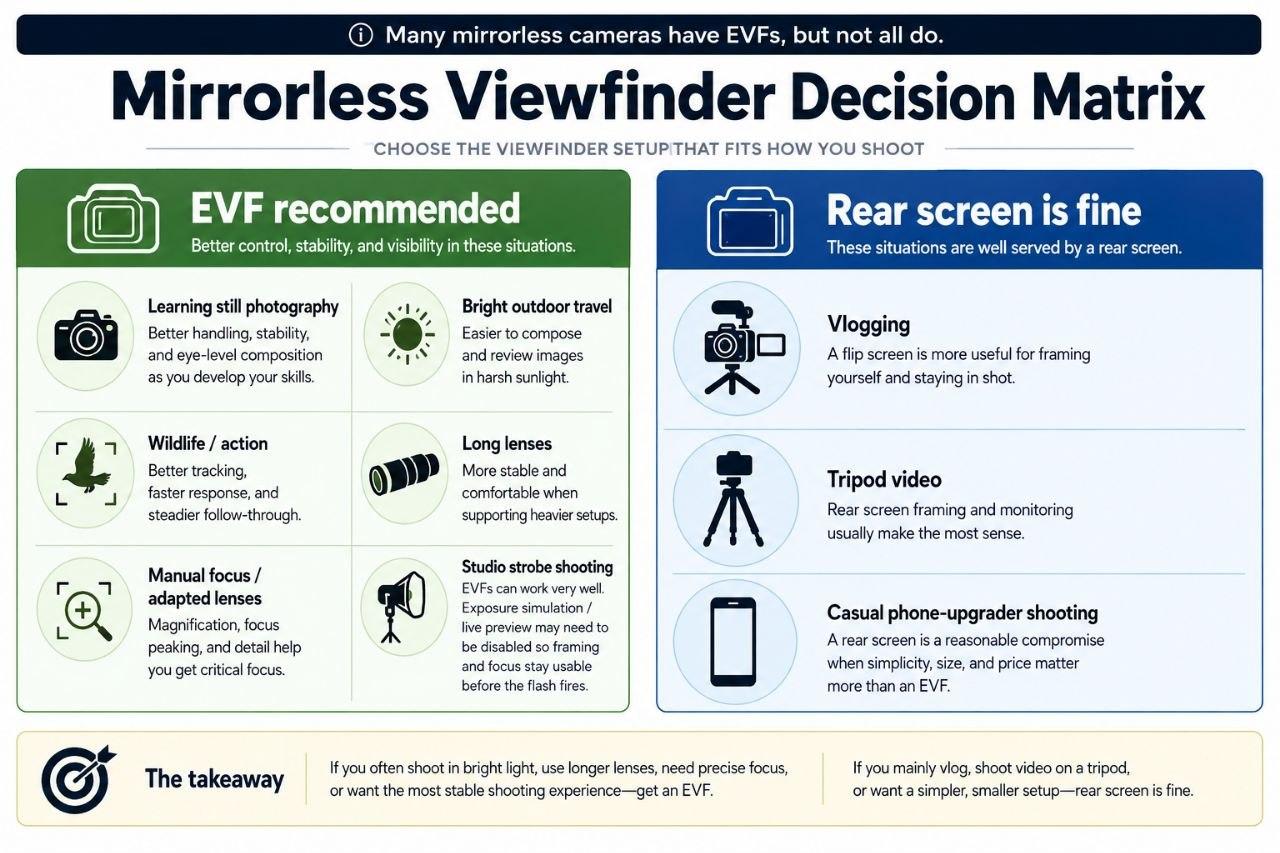
Mirrorless Viewfinder Decision Matrix
What kind of viewfinder does a mirrorless camera use?
A mirrorless camera does not use the same optical viewing system as a DSLR.
A DSLR uses a mirror and prism system that lets you look through the lens using an optical viewfinder. A mirrorless camera removes that mirror box, so it usually shows the scene either on the rear screen or through an electronic viewfinder.
An EVF is basically a very small display inside the eyepiece. Instead of showing a purely optical view, it shows a live feed from the image sensor.
That means an EVF can often show things an optical viewfinder cannot, including:
- exposure preview
- white balance preview
- picture-style or color-effect changes
- focus peaking
- magnified manual-focus views
- grid overlays or histograms
That does not automatically make an EVF better for everyone, but it does change the shooting experience.
Do all mirrorless cameras have viewfinders?
No. This is where many buyers get caught.
Some mirrorless cameras include a built-in EVF. Others rely only on the rear screen.
That is not an accident. It is often a design choice tied to cost, size, or a creator-focused audience.
For example:
- the Canon EOS R100 includes a built-in OLED electronic viewfinder
- the Nikon Z30 does not include a built-in viewfinder
- the Sony ZV-E10 also follows a rear-screen-first design with no built-in EVF
So the right mental model is not “mirrorless cameras have viewfinders.”
It is:
many mirrorless cameras have EVFs, but some are intentionally built without them.
EVF vs rear-screen-only, what changes in real use?
The biggest difference is not technical. It is practical.
A viewfinder changes how you compose, stabilize, and read the scene.
Where an EVF usually helps
An EVF is often useful when you:
- shoot still photos more than video
- work outdoors in bright sunlight
- use longer lenses
- want a steadier eye-level shooting position
- use manual focus or adapted lenses
- want to preview exposure and settings before taking the shot
Holding the camera to your face can make composition feel more controlled, and the eyecup helps block glare that can make a rear screen harder to see outdoors.
Where a rear-screen-only camera can be fine
A rear-screen-only mirrorless camera can work well when you:
- mainly vlog or film yourself
- mostly shoot indoors
- use a tripod or desk setup often
- want the smallest possible body
- are upgrading from a phone and already like screen-based shooting
- mainly take casual stills and short clips
This is why some creator-focused cameras deliberately skip the EVF. Their target user cares more about a flip screen, simple self-framing, compact size, and price than about eye-level still-photo shooting. If you are still sorting out the broader category first, what is a mirrorless digital camera gives the bigger context behind this tradeoff.
Why do some mirrorless cameras not have viewfinders?
There are usually four main reasons.
1. To keep the camera smaller
Removing the EVF hump can make a camera more compact and lighter.
2. To reduce cost
A built-in EVF adds hardware, so removing it can help hit a lower price point.
3. To prioritize creator-style shooting
Many video-first or social-content cameras are built around flip-screen use, not traditional eye-level composition.
4. To feel more familiar to phone upgraders
Some buyers are already comfortable composing on a screen. For them, skipping the EVF may not feel like a major loss at first.
The catch is that what feels fine in casual indoor shooting may feel much less fine in bright sun or when trying to hold a longer lens steadily.
Is an EVF better than a DSLR optical viewfinder?
Not automatically. They solve different problems.
EVF advantages
An EVF can be more informative.
It can help you see:
- how exposure changes affect the frame
- how white balance shifts the image
- focus aids for manual lenses
- overlays and shooting information
- a brighter live view in some low-light situations
For newer photographers, that feedback can make the camera feel easier to learn because you are seeing more of the effect before you take the shot.
Optical viewfinder advantages
A DSLR optical viewfinder still has real strengths.
It gives you:
- a direct, natural view of the scene
- no screen-style rendering of the image
- lower power use while viewing
- a shooting experience some people still prefer for fast action or long sessions
The honest answer
An EVF is often more useful for many modern users, but it is not universally better in every way.
If you care most about exposure preview, overlays, and flexible viewing tools, an EVF is usually more helpful.
If you strongly prefer a direct optical view and do not want an electronic display in the eyepiece, a DSLR optical viewfinder still has appeal.
When a viewfinder is worth paying for
For many people, this is the real buying question.
A viewfinder is usually worth it if you:
| Shooting situation | Viewfinder importance | Why |
|---|---|---|
| Learning still photography | High | It helps with stability, framing, and seeing settings feedback. |
| Bright outdoor travel | High | Rear screens can be hard to see in glare. |
| Wildlife, pets, or action | High | Eye-level shooting is often easier for tracking. |
| Long-lens shooting | High | Holding the camera to your face improves stability. |
| Manual focus or adapted lenses | Medium to high | EVF magnification and focus peaking can help. |
| Street or walkaround stills | Medium to high | Many photographers prefer eye-level composition outdoors. |
In plain terms, if the camera is mostly for stills, travel, outdoor use, or long lenses, an EVF is usually worth having.
When a rear-screen-only mirrorless camera is a reasonable compromise
A no-viewfinder camera is not automatically a bad buy.
It can make sense if you:
| Shooting situation | Rear-screen-only can be fine | Why |
|---|---|---|
| Vlogging or self-recording | Yes | A flip screen matters more than an EVF here. |
| Indoor casual shooting | Often | Screen glare is less of a problem. |
| Tripod video or desk setups | Often | Eye-level handheld framing matters less. |
| Phone-style everyday shooting | Sometimes | The workflow feels familiar. |
| Maximum compactness | Often | Skipping the EVF can reduce size and cost. |
If your camera use is mostly creator-style video, casual indoor shooting, or tripod-based work, an EVF may be less important than buyers expect.
Viewfinder needs by shooting style
This is where the decision becomes more obvious.
Travel and bright outdoor shooting
A viewfinder is often a real upgrade here.
Rear screens can become frustrating in strong sunlight, and eye-level framing tends to be more stable when you are moving quickly from scene to scene.
Family, kids, pets, and everyday stills
An EVF is often helpful, especially outdoors. It is not mandatory, but many people find still-photo shooting easier when they are not holding the camera at arm’s length all the time.
Wildlife, sport, and longer lenses
A viewfinder matters more here. Bracing the camera against your face helps, and tracking moving subjects on a rear screen can feel less controlled.
Vlogging and solo video
This is one of the clearest cases where a rear-screen-first camera can make perfect sense. If you mainly care about flip-screen framing, walking-and-talking clips, or tripod video, an EVF may not be the deciding feature.
Manual focus and adapted lenses
An EVF can be very helpful here because focus peaking and magnified views are easier to work with than a plain optical viewfinder. That does not make every mirrorless camera better for adapted lenses, but it does make the focusing experience more flexible. That is also why can you use DSLR lenses on mirrorless cameras is partly a viewfinder and usability question, not just a mount question.
EVFs and studio lighting, one caveat people forget
This is a real workflow issue, especially for photographers who shoot with strobes.
Many mirrorless cameras use exposure simulation or live exposure preview so the EVF reflects your current settings. That is helpful most of the time.
But under studio flash setups, your ambient light may be quite dark before the strobe fires. If the EVF is trying to preview the full exposure settings, the image can look so dark that framing and focusing become difficult.
That is why studio shooters often disable exposure simulation, or the equivalent menu option, when working with flash.
So the right takeaway is not “EVFs are bad for studio work.”
It is:
EVFs can be excellent in studio work, but they sometimes need the right setup so the preview stays bright enough before the flash fires.
That is a meaningful real-world caveat that does not show up in simple EVF-vs-OVF summaries.
Common mistakes when buying a mirrorless camera without a viewfinder
A few mistakes show up again and again.
Assuming every mirrorless camera has an EVF
Some do not. Always check the actual camera design.
Buying a creator camera when you mainly want stills
A rear-screen-first body may look modern and compact, but that does not mean it is the best fit for outdoor still photography.
Underestimating bright-sunlight shooting
A screen that feels fine indoors can become annoying fast outside.
Ignoring long-lens stability
Holding the camera to your eye often feels steadier than composing at arm’s length.
Treating all EVFs as equal
They are not. Size, clarity, refresh behavior, and general comfort can vary. This page is not the place for a deep spec comparison, but the quality difference is real.
Assuming a flip screen replaces a viewfinder in every situation
It does not. It helps a lot for video and self-recording, but it does not solve every still-photo use case.
So, should your mirrorless camera have a viewfinder?
For most people who mainly shoot stills, travel, outdoor scenes, action, or long-lens subjects, a mirrorless camera with an EVF is the safer choice.
For people who mainly vlog, shoot indoors, use a tripod often, or want the smallest creator-style body, a rear-screen-only mirrorless camera can be a reasonable compromise. If video is the real priority, are mirrorless cameras better for video is the cleaner next step than treating EVF preference as the whole decision.
The key is not to assume the answer is the same for everyone.
Many mirrorless cameras have viewfinders.
Some do not.
What matters is whether your style of shooting benefits enough from eye-level framing, outdoor visibility, and EVF feedback to make it worth prioritizing.
If you are still sorting out the bigger category decision, start with this guide to what a mirrorless camera is, then compare the broader mirrorless vs DSLR viewfinder differences and the more specific question of whether beginners should choose mirrorless.
