

A lot of tripod advice makes this sound easier than it is.
Carbon fiber is lighter. Aluminum is cheaper. Done.
That is the headline version. It is not the buying version.
Most photographers are not trying to win a tripod-material debate. They are trying to decide whether paying more for carbon fiber will actually make their tripod easier to carry, easier to use, and more likely to leave the house with them.
That is the real question this page should answer.
Table of contents
- Quick answer
- What tripod material actually changes
- Where aluminum makes more sense
- Where carbon fiber makes more sense
- Same model vs same budget, why the real comparison is messier than the headline
- Why material alone does not decide tripod quality
- Durability and damage tradeoffs without hype
- Shooting-style decision matrix
- When the carbon upgrade is worth it and when it is not
- Final buying takeaway
Quick answer
If you want the simplest version, it is this:
- carbon fiber usually saves weight
- aluminum usually saves money
- neither material automatically gives you the better tripod
That last point matters most.
A good aluminum tripod can make more sense than a cheaper carbon one.
A light carbon tripod can make more sense than a stronger-but-heavier aluminum tripod if carrying weight is the reason you keep leaving the tripod at home.
So the better choice depends less on the label and more on how you actually shoot.
What tripod material actually changes
Embed this infographic
Want to share this on your site? Copy the code below.
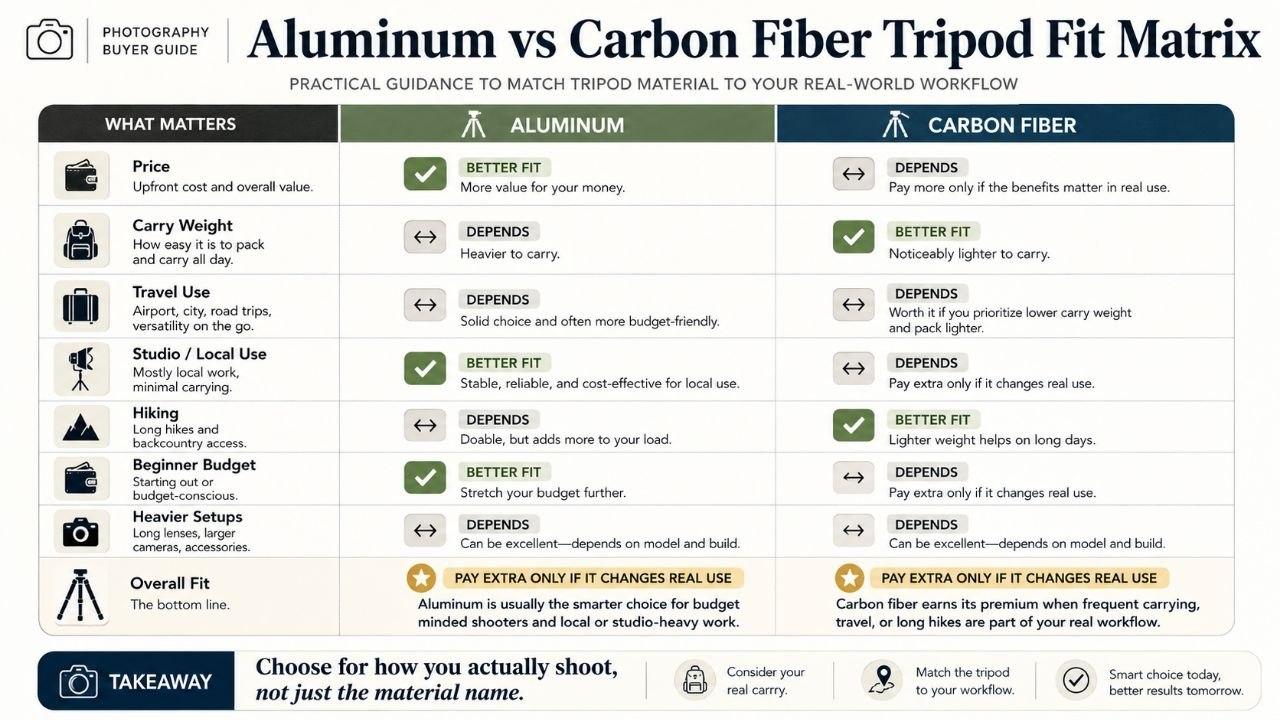
Tripod material can change several things at once:
- total carry weight
- leg stiffness
- price
- how much the tripod annoys you on long walks
- how the tripod responds to knocks or impact
- how attractive the upgrade feels compared with spending the same money somewhere else
What it does not do is settle the entire tripod decision on its own.
Head quality still matters. Leg diameter still matters. Lock design still matters. Center-column design still matters. Working height still matters.
That is why “carbon vs aluminum” is a real decision, but not the only one.
Where aluminum makes more sense
Aluminum is often the smarter buy when:
- budget matters more than shaving every bit of carry weight
- the tripod mostly lives in a car, studio, or home setup
- you want solid value without paying extra for lighter legs
- you would rather put more money into overall tripod quality than into material alone
Digital Photography School describes aluminum as the tripod-material workhorse because it gives a strong compromise between price, rigidity, and weight.
That is a useful way to think about it.
Aluminum is usually not the glamorous answer. It is often the practical one.
Where carbon fiber makes more sense
Carbon fiber makes more sense when:
- you hike or travel with the tripod often
- carry weight affects whether you bring the tripod at all
- you want a lighter tripod without dropping into very flimsy territory
- you shoot on the move enough that the weight penalty of aluminum keeps showing up in real use
Digital Camera World makes the most important practical point here: the leg tubes may be carbon fiber, but other parts of the tripod still rely on metal components. So the whole tripod does not magically become featherweight just because it is sold as carbon fiber.
That matters because buyers often expect a bigger transformation than they get.
The weight saving is real. It is just not the whole story.
Same model vs same budget, why the real comparison is messier than the headline
Embed this infographic
Want to share this on your site? Copy the code below.
This is where many pages get lazy.
The easy comparison is:
- carbon fiber version of tripod A
- aluminum version of tripod A
That can be useful.
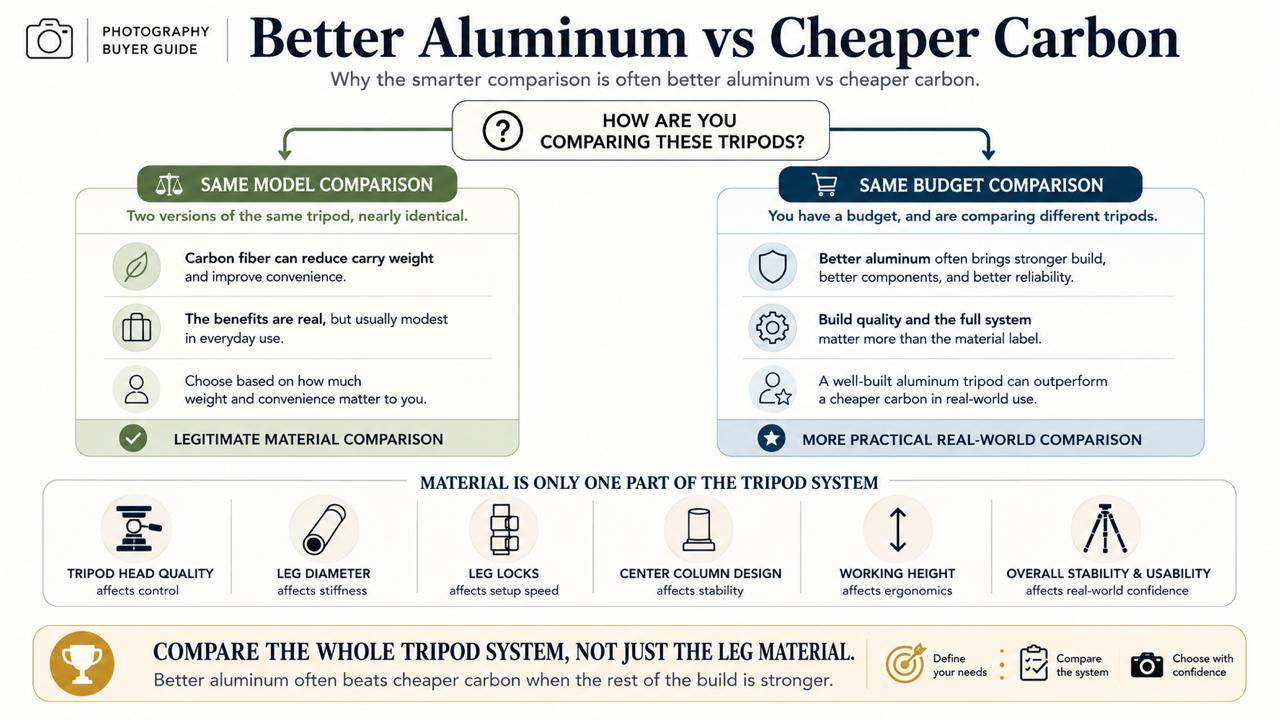
But real buyers often compare by budget instead.
That means the real decision may be closer to:
- a better aluminum tripod with stronger overall specs
- versus a cheaper carbon tripod that wins on weight but loses somewhere else
That is why “carbon fiber is better” can be misleading.
The better question is:
What do I get for the extra money, and does that upgrade matter for how I actually shoot?
If lighter weight changes how often you carry the tripod, carbon fiber may be worth it.
If the tripod mostly stays near the car, inside the studio, or beside a desk, aluminum may be the smarter use of the same budget.
Why material alone does not decide tripod quality
A tripod is a system, not just a material choice.
Two tripods can have different real-world value even if the material headline makes one sound better.
Things that still matter heavily include:
- leg diameter
- number of leg sections
- head quality
- center-column design
- working height
- folded length
- lock quality
- feet and ground contact
This is why a carbon fiber badge should not end the conversation.
It may improve the carry experience. It does not automatically fix a weak head, an annoying center column, or a design that does not fit how you shoot.
Durability and damage tradeoffs without hype
Material comparisons also get overdramatic fast.
A more useful way to frame it is this:
- aluminum is commonly framed as more likely to bend or dent from impact
- carbon fiber is commonly framed as more prone to cracking from sharp impact
That does not mean one material is fragile junk and the other is indestructible.
It means they tend to fail differently.
That is a much safer and more honest way to explain the tradeoff.
Shooting-style decision matrix
Studio, indoor, or mostly car-based shooting
Aluminum often makes a lot of sense here.
If you are not carrying the tripod far, paying extra for weight savings may not improve your day enough to justify the cost.
Hiking and travel photography
Carbon fiber becomes much easier to justify here.
If less weight means you will actually bring the tripod, that benefit is practical, not theoretical.
Beginner buyers on a tighter budget
Aluminum is often the better starting point.
The smarter move may be buying a better overall aluminum tripod instead of chasing carbon fiber too early.
Vlogging and creator setups
This depends.
If the setup travels often, weight matters. If the tripod mostly stays near a desk or home filming setup, material matters less than size, speed, and head behavior.
That is why it can help to browse lightweight vlogging tripod options after you decide whether portability is actually central to the job.
DSLR or heavier-lens buyers
Material matters, but not by itself.
If you are shopping around a bigger DSLR setup, head quality, stiffness, load handling, and general support confidence may matter more than leg material alone. In that case, it helps to see DSLR tripods where weight and stability both matter.
When the carbon upgrade is worth it and when it is not
Carbon fiber is usually worth stronger consideration when:
- you walk with the tripod often
- you travel enough that packed weight is annoying every time
- you know a heavier tripod gets left behind too often
- you already care about tripod quality and want to reduce carry friction without dropping too far in support quality
Carbon fiber is usually less compelling when:
- the tripod mostly stays local
- the budget is better spent on overall tripod quality
- the material upgrade would force bigger compromises elsewhere
- you are paying extra for the label more than the real use-case benefit
This is also why the “worth it” question is personal.
The right answer changes depending on whether you carry the tripod 20 meters from the car or 5 kilometers up a trail.
Final buying takeaway
The cleanest way to think about this is simple:
- aluminum is often the value play
- carbon fiber is often the portability play
- neither one is automatically the better tripod
If you want general shortlist options after deciding where you stand on the tradeoff, compare general tripod picks after choosing a material.
If you care more about a DSLR setup where support confidence matters alongside weight, it also helps to choose between aluminum and carbon fiber for a DSLR tripod.
If you are still balancing the rest of the support decision, it also helps to check how much tripod load capacity you actually need, whether a ball head or pan head suits the job better, and whether a travel tripod or full-size tripod fits the way you carry and use it.
And if portability is the whole reason this question matters to you, the next useful step may be deciding whether the smaller carry penalty is enough to justify the upgrade.
That is the real decision, not whether one material wins on paper.
