


A smaller tripod sounds easy to love.
It packs more neatly, weighs less, and feels more realistic to carry when you are already dragging a camera bag around.
That is why travel tripods are easy to want.
But that does not automatically make them the better tripod.
A tripod that is nicer to carry can still be more annoying to use once you reach the spot, especially if you start giving up too much height, stiffness, or general comfort.
That is the real decision here.
It is not travel tripod versus full-size tripod in theory.
It is which compromise bothers you less in real use.
Table of contents
- Quick answer
- What this choice actually changes in real use
- Where a travel tripod makes more sense
- Where a full-size tripod makes more sense
- Why portability can help or hurt depending on how far you carry the tripod
- Why maximum height and center-column reliance matter more than they sound
- Stability and support confidence without overclaiming
- Use-case grid
- When compact carry is worth the compromise and when it is not
- Final buying takeaway
Quick answer
For most buyers, the short version looks like this:
- travel tripods usually win on packing and carry convenience
- full-size tripods usually win on working comfort and support confidence
- neither one is automatically the smarter buy without the use case
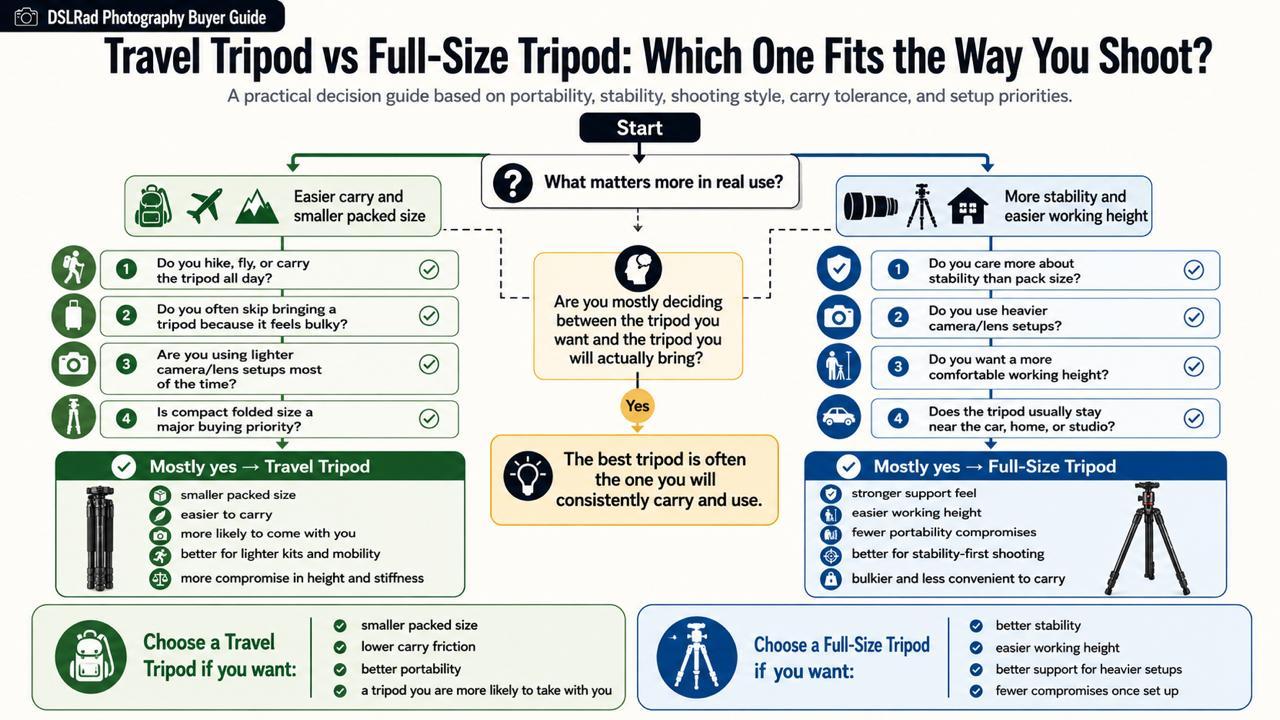
If you hike, fly, or carry the tripod all day, the travel format can make a lot of sense.
If the tripod mostly stays local and you care more about height, easier setup, or a less compromised shooting position, a full-size tripod can make more sense.
What this choice actually changes in real use
Embed this infographic
Want to share this on your site? Copy the code below.
This decision affects more than bag size.
It changes:
- how likely you are to bring the tripod at all
- how comfortable the tripod feels once you set it up
- how often you rely on the center column to reach useful height
- how much working room you have before the setup starts to feel compromised
- how annoying the tripod feels on long days or repeated location moves
That is why a compact tripod can feel smart on paper and irritating in practice, or a full-size tripod can feel excessive in the store and perfect once you start using it locally.
Where a travel tripod makes more sense
A travel tripod makes more sense when carry friction is the real problem.
That usually means:
- hiking photography
- flights and tight packing limits
- travel-heavy shooting
- creator setups where portability matters more than maximum support confidence
- situations where a larger tripod gets left behind too often
Digital Camera World sums up the category well. A travel tripod has to be small enough to pack, light enough to carry, and still sturdy enough for shake-free photos.
That line captures the whole category.
A travel tripod is about making support realistic to bring along, not about winning every performance tradeoff.
Where a full-size tripod makes more sense
A full-size tripod makes more sense when the tripod is used more than it is carried.
That usually means:
- local landscape photography
- home or studio use
- car-based shooting
- situations where more height and less compromise matter more than folded size
- buyers who would rather have easier working comfort than the smallest possible bag fit
This is where many people overcorrect toward portability.
If the tripod usually starts close to the car, the front door, or the studio, shaving every inch and ounce may not improve your actual shooting day very much.
Why portability can help or hurt depending on how far you carry the tripod
Portability helps when it changes behavior.
If a travel tripod is the version you will actually carry, that matters.
But portability can also hurt when it creates small frustrations every time you shoot.
A more compact tripod may mean:
- lower working height
- more reliance on the center column
- less comfortable eye-level use
- more compromise if you want a sturdier-feeling setup
Those tradeoffs are not always dealbreakers.
They are just the part people forget when they focus only on packing size.
Why maximum height and center-column reliance matter more than they sound
This part is easy to underestimate.
A tripod that looks tall enough in the spec sheet may still depend heavily on the center column to reach a comfortable working height.
That matters because the difference between “usable” and “comfortable” is real.
If you constantly need to extend the center column to get the tripod where you want it, the compact design may stop feeling clever and start feeling like a workaround.
That does not mean travel tripods are bad.
It means working height should be judged by how you actually use the tripod, not just by the headline number.
Stability and support confidence without overclaiming
This is where people often drift into lazy gear language.
A full-size tripod is not automatically superior just because it is larger.
A travel tripod is not automatically shaky just because it packs smaller.
The safer way to frame it is this:
- travel tripods usually accept more portability-first compromises
- full-size tripods usually give you a less compromised working platform
- the value of either one depends on the job
That is a much more useful buying frame than pretending one format wins everywhere.
Use-case grid
Embed this infographic
Want to share this on your site? Copy the code below.
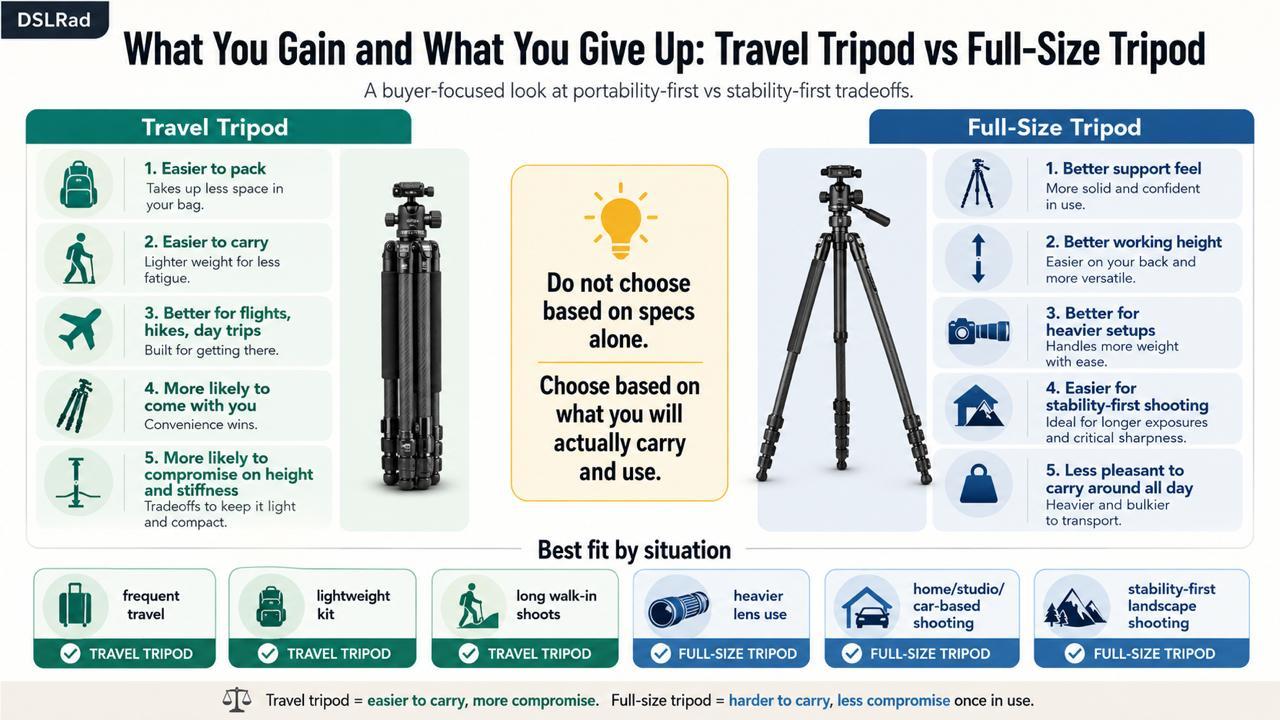
Hiking and travel photography
A travel tripod usually makes more sense.
If the choice is between carrying a smaller tripod or leaving a larger one behind, the smaller format may be the more useful real-world tool.
Local landscape photography
A full-size tripod often makes more sense.
If you are not carrying it far, easier working height and a less portability-compromised setup can be more valuable than a smaller folded size.
Home and studio use
A full-size tripod usually makes more sense here as well.
If the tripod mostly stays close, portability matters less than comfort and working ease.
Creator and vlogging setups
This depends on how mobile the setup needs to be.
If portability is central, it helps to browse compact tripod options for creator setups.
If the tripod is mostly going to stay in one place, a larger support may still be the easier long-term choice.
Heavier DSLR setups
This is where support confidence matters more.
If the setup is larger and you care more about a less compromised support platform, it helps to see DSLR tripods where support confidence matters more.
When compact carry is worth the compromise and when it is not
A travel tripod is usually worth it when:
- the tripod has to fit inside real travel limits
- carry distance is long enough that weight changes behavior
- you know a larger tripod gets left behind
- portability is not just nice to have, but essential to the job
A full-size tripod is usually worth it when:
- you rarely carry the tripod far
- you care more about easy setup comfort
- you want fewer portability-first compromises
- the tripod is part of local, home, or studio work more than all-day travel
That is the simplest way to think about it.
Final buying takeaway
A travel tripod is usually the better choice when the real problem is getting a tripod to come with you at all.
A full-size tripod is usually the better choice when the real problem is wanting a more comfortable, less compromised setup once you start shooting.
Neither format is automatically better.
It just depends on whether packing convenience or working comfort matters more for your photography.
If you want broader shortlist options after choosing the format, compare general tripod picks after choosing the format.
If portability is the whole reason the decision matters, creator-friendly and compact options may also be the next useful step.
Before you decide, it also helps to check how much support margin your setup actually needs, whether aluminum or carbon fiber is the better tradeoff, and whether a ball head or pan head matches the way you shoot.
And if support confidence matters more than packed size, it makes sense to keep that higher on the buying list than pure portability.
