


Tripod shopping gets messy fast because people often focus on the legs first.
That makes sense up to a point. Weight, height, folded size, and load rating all matter.
But sometimes the part that changes the day-to-day experience more is the head.
That is where the real friction often shows up.
A tripod head can make setup feel quick and intuitive, or slow and exact. It can help you recompose fast, or help you dial in a level frame one axis at a time.
That is why the better question is not “which head is best?”
It is which head fits the way you actually shoot?
Table of contents
- Quick answer
- What each head type actually changes
- Where a ball head makes more sense
- Where a pan head makes more sense
- Why photographers often confuse pan heads with fluid video heads
- Why head choice can matter more than small leg-spec differences
- Size, packing, and setup-speed tradeoffs
- Use-case grid
- When to choose speed and when to choose precise control
- Final buying takeaway
Quick answer
For most photographers, the short version looks like this:
- ball heads are usually faster
- pan heads are usually more precise
- neither one is automatically the better choice for everyone
That tradeoff matters more than a feature checklist.
If you recompose often and want speed, a ball head usually makes more sense.
If you care more about careful framing and axis-by-axis control, a pan head usually makes more sense.
What each head type actually changes
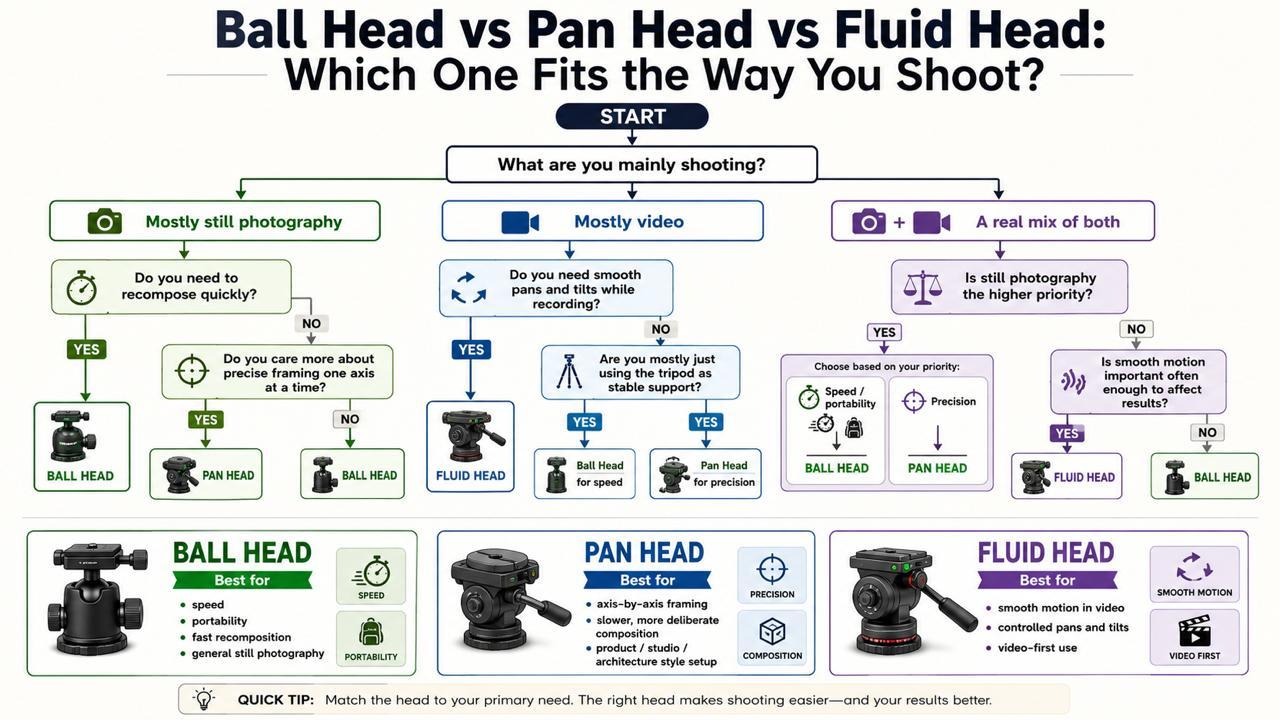
Embed this infographic
Want to share this on your site? Copy the code below.
A tripod head changes how you move the camera once it is mounted.
That sounds obvious, but it is the reason this decision matters.
The head affects:
- how quickly you can reposition the camera
- how easy it is to level and fine-tune the frame
- how annoying the setup feels when you need repeated adjustments
- how bulky the tripod becomes in a bag
- how natural the tripod feels for stills versus controlled movement
This is why two similar tripods can feel very different in real use.
Where a ball head makes more sense
Ball heads are popular for a reason.
They are simple, quick to use, and usually easier to carry. A single main lock controls broad movement, which makes them feel intuitive when you want to reframe quickly.
That is especially useful for:
- travel photography
- general outdoor shooting
- casual landscape work where speed still matters
- photographers who do not want to fight multiple handles or knobs
- setups where lower bulk matters in the bag
Lensrentals describes ball heads as easy to use and broad in range of motion, while also noting that precision is usually where they give something up.
That is the tradeoff in one sentence.
Where a pan head makes more sense
Pan heads make more sense when you care more about controlled framing than speed.
Instead of releasing broad movement all at once, you adjust axes separately. That usually means more deliberate setup, but also more precise control.
That can be useful for:
- product photography
- architecture and straight-line framing
- careful landscape composition
- studio work
- any situation where one-axis-at-a-time adjustment feels worth the slower setup
SLR Lounge and Lensrentals both describe this same tradeoff clearly: pan heads are usually slower and bulkier, but they give you more exact control.
Why photographers often confuse pan heads with fluid video heads
This is one place where pages often get sloppy.
A pan head for still photography is not automatically the same thing as a fluid video head.
There is overlap in the idea of controlled axis movement, but they are not interchangeable categories in every useful sense.
That matters because some readers really mean:
- a basic pan-and-tilt head for stills
- a more controlled head for product or studio framing
- or a true video-oriented fluid head for smoother motion
Those are related decisions, but not identical ones.
So if you mainly shoot video or creator content, do not assume every pan head solves the same problem the way a dedicated fluid head does.
Why head choice can matter more than small leg-spec differences
This is easy to miss when shopping.
People compare leg materials, section counts, or a small difference in folded length, then live with a head style that annoys them every time they shoot.
That is backwards.
If your tripod head fights the way you work, the rest of the setup can still feel wrong.
A fast-moving photographer may hate a head that takes too long to adjust.
A careful composition-first shooter may hate a head that makes every fine correction feel loose or imprecise.
That is why this decision has real buying value. The head can shape the whole experience more than minor spec differences elsewhere.
Size, packing, and setup-speed tradeoffs
Ball heads usually win the packing and simplicity argument.
They tend to be smaller, cleaner, and easier to live with when the tripod needs to move often.
Pan heads usually give back some portability in exchange for control. More handles, more knobs, and more axis-specific adjustment means more bulk.
That does not make pan heads bad. It just means they ask for a different kind of tolerance.
If a tripod spends most of its time near the car or in a studio, that extra bulk may not matter much.
If the tripod lives in a travel bag, it probably matters more.
This is also where it helps to pair the head decision with broader tripod choices like ball head vs pan head tripod tradeoffs and eventual travel-versus-full-size use.
Use-case grid
Travel photography
A ball head usually makes more sense.
It is typically quicker and easier to pack, which matters more when the tripod has to come along all day.
Landscape photography
This depends on how you work.
If you recompose quickly and want a lighter-feeling setup, a ball head can be enough.
If you prefer slower, more deliberate framing, a pan head can be appealing.
Product and studio photography
A pan head usually makes more sense here.
The value is not speed. The value is precise adjustment without disturbing the other axes.
Video and creator work
This depends on whether you really need controlled motion or just a stable support platform.
If your work leans toward vlogging, compact creator setups, or lighter carry needs, it helps to browse lighter tripod options for creator setups.
If your work is truly motion-focused video, the next question may be whether you need a fluid head rather than just a standard pan head.
DSLR setups and heavier combinations
This is where head behavior and support confidence need to be considered together.
If you are choosing a tripod for a DSLR setup where head control matters as much as the legs, it helps to see DSLR tripods where head control and support both matter.
When to choose speed and when to choose precise control
Choose a ball head when:
- you want faster repositioning
- you care about compact carry
- you shoot more dynamically
- you do not need axis-by-axis precision often
Choose a pan head when:
- you care more about exact framing than speed
- you work more deliberately
- you do product, studio, or careful composition work
- you accept more bulk in exchange for control
That is the cleanest way to think about it.
This is not really a debate about which head is better.
It is a decision about which frustration you would rather avoid.
Final buying takeaway
A ball head usually fits photographers who want speed, simplicity, and lower bulk.
A pan head usually fits photographers who want more control, more deliberate framing, and less all-at-once movement.
Neither choice is automatically more serious or more professional.
It just needs to fit the work.
If you want broader shortlist options after deciding on the head style, compare general tripod picks after choosing the head style.
If the real issue is a DSLR setup where support confidence and head behavior need to work together, choose a tripod head for DSLR photography is the more useful next step.
It also helps to pair that head choice with enough load-capacity margin for your setup, the right tripod material tradeoff, and the right travel-versus-full-size format.
And if packing weight and carry friction are part of the bigger tripod decision, material and portability may matter just as much as the head itself.
